Hot vulcanized silicone O-rings are a practical choice for static sealing applications requiring custom dimensions, large diameters, or sizes not readily available in standard molded O-rings. By joining precisely cut silicone cord through a controlled vulcanization process, we can produce continuous O-rings tailored to specific sealing requirements.
For engineers and buyers, the performance of a vulcanized O-ring depends on more than the joint itself. Silicone grade, cross-section, hardness, compression, groove design, temperature, pressure, and media exposure all influence how the seal performs in service.
At Elastostar Rubber Corporation, we support custom sealing projects with Made in USA manufacturing, reverse engineering, design and application support, and prototype-to-production capabilities.
This guide explains how Hot Vulcanized Silicone O-Rings are made, why they are well suited for static sealing, how they compare with cold-bonded and molded O-rings, and what to consider before specifying a custom O-ring.
Key Takeaways
- Hot-vulcanized silicone O-rings are ideal for custom, large-diameter static sealing.
- They support non-standard sizes without dedicated full-ring mold tooling.
- Seal performance depends on material, compression, gland design, temperature, and pressure.
- Silicone, Viton/FKM, EPDM, and Nitrile should be selected based on service conditions.
- Vulcanized O-rings are useful for prototype, replacement, and custom production requirements.
- Joint quality and dimensional consistency are important for reliable static sealing.
- Large-diameter O-rings can support housings, covers, vessels, enclosures, and industrial equipment.
- We provide Made in USA custom manufacturing, reverse engineering, and prototype-to-production support.
Table of Contents
What Are Hot Vulcanized O-Rings?

Hot vulcanized silicone O-rings are custom sealing rings made by cutting extruded silicone cord to the required length and joining the ends through a controlled vulcanization process.
The result is a continuous ring produced to a specified diameter and cross-section.
They are especially useful when:
- Standard molded O-ring sizes are not available.
- Large-diameter O-rings are required.
- A custom diameter or cross-section is needed.
- Prototype or lower-volume production makes dedicated mold tooling less practical.
We can manufacture these rings from silicone rubber cord based on the required size, hardness, material grade, and application conditions.
Read More: A Complete Guide: What Is Rubber Silicone O-Rings?
How Does Hot Vulcanization Work in Silicone O-Ring Manufacturing?
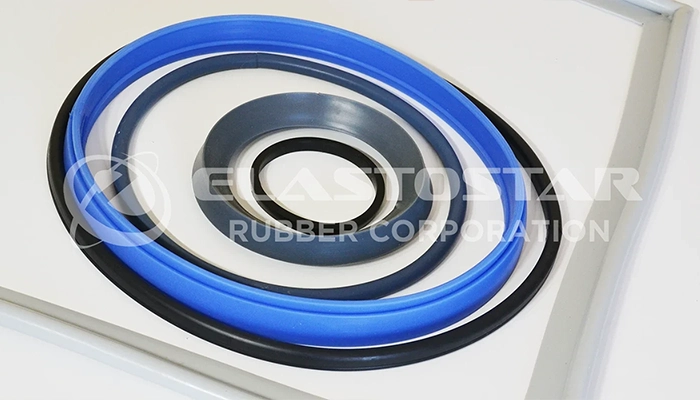
Hot vulcanization creates a continuous O-ring by joining the prepared ends of extruded silicone cord using heat, pressure, and compatible uncured silicone material.
The exact manufacturing process can vary according to the silicone compound, cross-section, and finished O-ring requirements.
A typical process includes:
- Extruding the silicone cord to the required cross-section.
- Cutting the cord to a controlled length based on the specified finished O-ring diameter.
- Preparing and aligning the ends to help maintain cross-sectional consistency at the joint.
- Applying compatible silicone joining material and placing the joint in vulcanizing tooling.
- Applying controlled heat and pressure to cure the joint.
- Finishing and inspecting the O-ring for joint quality and dimensional requirements.
For static sealing, proper joint alignment and dimensional consistency are important because irregularities at the splice can affect compression and sealing contact.
Our quality control processes support dimensional and manufacturing requirements for custom rubber components.
Why Are Hot Vulcanized Silicone O-Rings Suitable for Static Sealing?
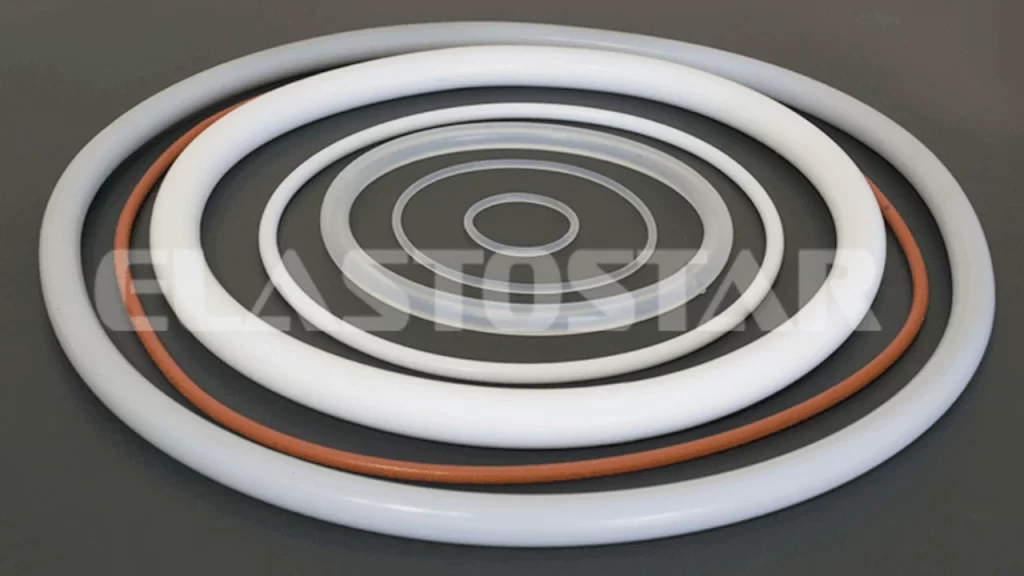
Hot vulcanized silicone O-rings are well suited to static sealing because they remain compressed between mating surfaces with no intended relative movement during operation.
Without continuous sliding or rotation, the seal experiences less friction and wear than it would in a dynamic application, making vulcanized O-rings particularly practical for custom static assemblies.
They are commonly considered for static sealing because they provide:
- Custom and large-diameter sizes when standard molded O-rings are unavailable.
- Good flexibility across a broad temperature range.
- Resistance to ozone, UV, and weathering.
- Custom cross-sections, hardness options, and silicone grades based on application requirements.
- A practical solution for housings, covers, flanges, enclosures, and other stationary joints.
Material selection should still be appropriate for the service environment.
While silicone is valuable for temperature flexibility and environmental resistance, Viton/FKM vulcanized O-rings may be considered for oils, fuels, and many chemicals; EPDM is commonly used for water, steam, ozone, and weathering; and Nitrile (NBR) is widely used with petroleum-based oils and fuels.
Regardless of material, reliable static sealing depends on correct compression, gland dimensions, pressure, temperature, media compatibility, and the quality of the finished O-ring.
Key Advantages of Hot Vulcanized Silicone O-Rings as Static Seals
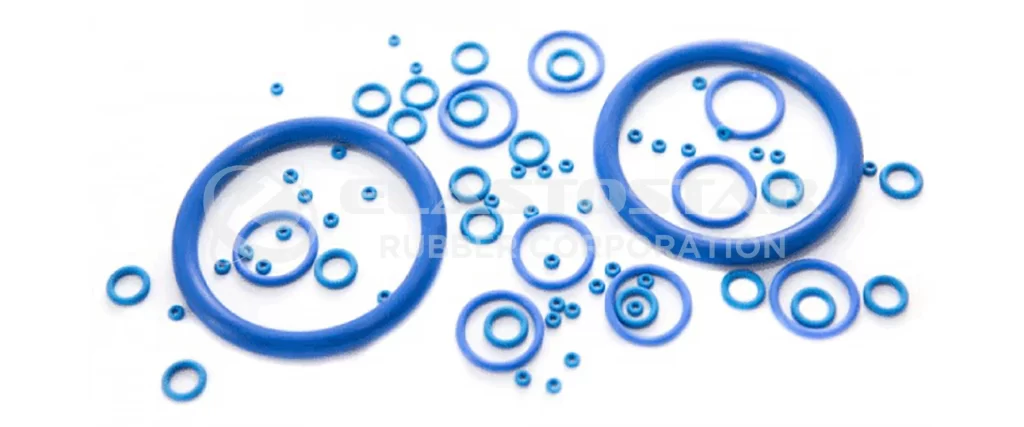
The main advantage of hot vulcanized silicone O-rings is their flexibility in custom static sealing applications.
They can be produced in sizes and diameters that may not be practical or readily available as standard molded O-rings.
Key benefits include:
- Custom diameters for non-standard equipment and sealing designs.
- Large-diameter O-rings for housings, covers, vessels, and enclosures.
- Reduced tooling needs compared with creating a new molded O-ring size.
- Custom cross-sections and hardness options based on the application.
- Prototype-to-production flexibility for low-volume and repeat requirements.
- Replacement support for obsolete or difficult-to-source static seals.
For engineers, one of the main advantages is design flexibility. We can manufacture custom silicone static seals around drawings, dimensions, samples, and application requirements.
Where dimensional control is important, our RMA Precision Tolerance guide provides reference information for extruded and spliced rubber product tolerances.
Hot Vulcanized vs Cold-Bonded O-Rings: Key Differences
Both hot vulcanized and cold-bonded O-rings can be produced by joining the ends of extruded rubber cord, but the joining methods are different.
This difference can affect joint consistency, manufacturing time, and suitability for the intended static sealing application.
| Factor | Hot Vulcanized O-Rings | Cold-Bonded O-Rings |
|---|---|---|
| Joining Method | Ends are joined using a controlled vulcanization process involving heat | Ends are joined using an adhesive bonding system |
| Joint Formation | Creates a cured rubber-to-rubber splice | Relies on the adhesive bond between prepared surfaces |
| Processing | Requires vulcanizing equipment and controlled process conditions | Generally requires less processing equipment |
| Custom Sizes | Suitable for custom and large-diameter O-rings | Can also be produced in custom diameters |
| Static Sealing | Well suited to many custom static sealing applications | Suitability depends on adhesive, elastomer, media, temperature, and service conditions |
| Selection | Useful where a vulcanized splice is specified or preferred | May be considered where the bonding system meets application requirements |
A hot-vulcanized joint should not automatically be described as equal to a one-piece molded O-ring.
Finished performance depends on the elastomer compound, splice preparation, curing conditions, joint geometry, dimensions, and actual service environment.
For demanding applications, engineers should evaluate the complete O-ring seal rather than choosing between hot vulcanization and cold bonding based solely on the joining method.
Hot Vulcanized vs Molded Silicone O-Rings: When Should Each Be Used?

Both hot-vulcanized and molded silicone O-rings can provide effective static sealing, but they are manufactured differently and suit different production and design requirements.
The better choice depends on the required diameter, quantity, tooling, tolerances, and service conditions.
| Factor | Hot Vulcanized Silicone O-Rings | Molded Silicone O-Rings |
|---|---|---|
| Construction | Extruded silicone cord is cut and vulcanized at the joint | Formed and cured as a one-piece ring in a mold |
| Custom Diameters | Well suited to custom and non-standard diameters | Custom sizes generally require appropriate mold tooling |
| Large Diameters | Practical for many large-diameter sealing requirements | Large custom sizes may require dedicated tooling |
| Tooling | Can reduce the need for a dedicated full-ring mold | Requires suitable mold tooling |
| Production Quantity | Useful for prototypes, replacements, custom sizes, and suitable production runs | Often advantageous for repeat production where tooling is justified |
| Joint | Contains a vulcanized splice | No spliced joint |
| Selection | Strong option when dimensional flexibility is important | Strong option when one-piece molded construction is specified or preferred |
Elastostar manufactures custom-molded rubber products, hot-splice endless rings, and vulcanized frame gaskets, allowing the manufacturing method to be selected based on the actual component and production requirements.
A hot vulcanized O-ring should not automatically be considered better or worse than a molded O-ring. Engineers should base the decision on seal geometry, diameter, quantity, tolerances, pressure, temperature, media exposure, and application requirements.
How Joint Quality Affects Static Seal Performance
The vulcanized joint is an important part of a spliced vulcanized O-ring, but reliable static sealing depends on the quality and dimensional consistency of the entire finished ring.
A poorly prepared or misaligned splice can create a local variation in the cross-section, which may affect compression and sealing contact within the gland.
Important joint-quality factors include:
- End preparation: The mating surfaces should be prepared consistently before joining.
- Joint alignment: The cord ends should be aligned to minimize steps, offsets, or distortion at the splice.
- Controlled vulcanization: Cure conditions must be appropriate for the silicone compound and joining process.
- Cross-section consistency: Excessive variation at the joint can change local O-ring compression.
- Finished dimensions: The O-ring diameter and cross-section must meet the specified dimensional requirements.
- Inspection: The completed joint should be checked for visible defects, alignment, dimensions, and overall workmanship.
Joint quality alone does not determine whether a static O-ring will seal successfully. Groove geometry, squeeze, pressure, temperature, media compatibility, silicone compound, surface condition, and installation also influence performance.
For aerospace applications requiring controlled manufacturing and quality processes, our AS9100D-certified manufacturing capabilities support aerospace quality-management requirements.
The applicable material specification, such as A-A-59588 or ZZ-R-765, should still be specified separately when required by the drawing or application.
Are Hot Vulcanized O-Rings Suitable for Large-Diameter Sealing Applications?
Yes. Hot vulcanized silicone O-rings are particularly useful when a sealing application requires a large or non-standard diameter that may be impractical to produce as a molded ring.
Extruded cord can be cut to the required circumference and joined to create a custom-sized static seal, giving engineers more flexibility for oversized equipment and enclosures.
Typical large-diameter static applications include:
- Equipment housings and access covers.
- Industrial ovens and large enclosures.
- Vessel, tank, and manway sealing.
- Aerospace and test-equipment housings.
- Large OEM assemblies where standard O-ring sizes do not fit.
Where manway-style or large-equipment sealing is required, our U-channel manway seals and gaskets provide another relevant custom sealing option.
Temperature, Compression Set, and Environmental Considerations for Silicone Static Seals
For silicone static seals, reliable long-term performance depends on temperature, compression set, environmental exposure, pressure, and compatibility with the media contacting the O-ring.
1. Temperature Performance
Silicone maintains flexibility across a broad temperature range, making high-temperature silicone O-rings useful for many static sealing applications.
Because performance varies by compound and grade, engineers should review the required service conditions against the appropriate silicone rubber material properties and grades before specifying the O-ring.
2. Compression Set
A static O-ring remains compressed for extended periods, making compression set an important consideration. If the material takes a permanent set, it may lose some of its ability to recover and maintain sealing contact. Temperature, compression level, compound formulation, and time under compression can all influence this behavior.
3. Environmental and Media Exposure
Silicone provides good resistance to ozone, UV, and weathering, but it is not the right elastomer for every fluid environment.
Depending on service conditions, Viton/FKM may be considered for oils, fuels, and many chemicals; EPDM for water, steam, ozone, and weather exposure; and Nitrile (NBR) for many petroleum-based oil applications.
Applications of Hot Vulcanized Silicone O-Rings Across Key Industries
Hot vulcanized silicone O-rings are used in applications that require custom dimensions, large diameters, or non-standard static sealing.
The silicone grade and applicable standards should be selected according to the operating environment and industry requirements.
1.Aerospace
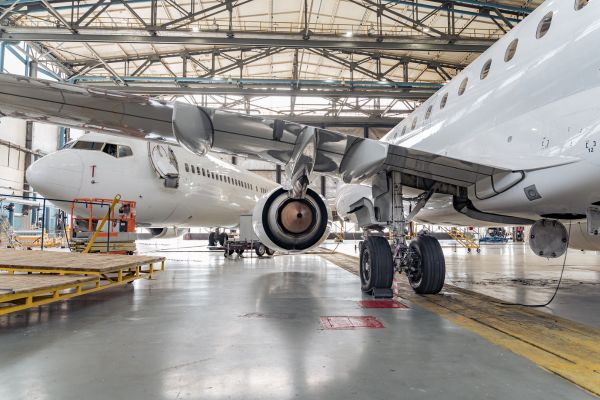
In aerospace equipment, custom vulcanized O-rings can be used for static sealing in housings, access panels, enclosures, and other assemblies.
Where specified by the drawing or customer, materials such as A-A-59588 silicone rubber or ZZ-R-765 Class 2A, 2B, 3A, and 3B may be applicable.
2. Food Processing

For food-contact equipment, Food Grade Silicone (177.2600) may be required to meet FDA 21 CFR 177.2600 requirements.
We also offer metal and X-ray detectable silicone rubber for applications where foreign-material detection is part of the food-safety program.
3. Medical and Pharmaceutical
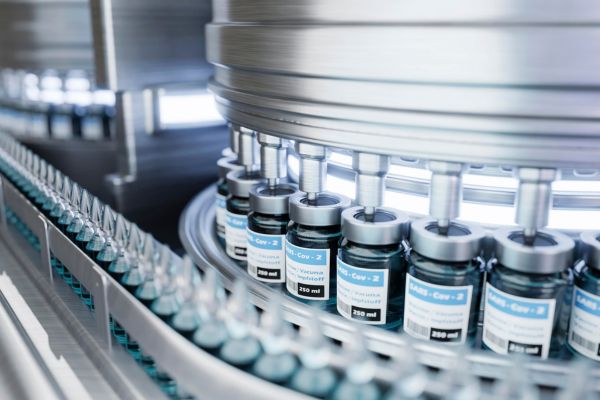
Medical and pharmaceutical equipment may require silicone materials meeting USP Class VI, Sections 87 & 88, depending on the application. Custom silicone O-rings can be manufactured for equipment housings, connections, and other static sealing interfaces.
4. Industrial Equipment

Large-diameter vulcanized silicone O-rings can be used in industrial ovens, HVAC equipment, machinery, processing equipment, and large enclosures.
Material selection should account for temperature, compression, pressure, media exposure, and the required service environment.
Read More: High-Temperature O-Rings for Industrial Applications
Common Causes of Static O-Ring Failure and How to Reduce Them
Static O-ring failure usually results from a combination of material selection, gland design, compression, pressure, temperature, media exposure, and installation rather than from a single cause.
| Common Cause | How to Reduce the Risk |
|---|---|
| Too little compression | Review gland dimensions and required squeeze. |
| Excessive compression | Avoid over-compressing the O-ring in the groove. |
| Incorrect material | Match Silicone, Viton/FKM, EPDM, or Nitrile to the actual media and temperature. |
| Pressure extrusion | Review clearance, pressure, and material hardness. |
| Compression set | Select the right silicone compound and compression level. |
| Joint defects | Check splice alignment, joint consistency, and finished dimensions. |
| Installation damage | Avoid cuts, twisting, stretching, or sharp edges during assembly. |
For hot-vulcanized silicone O-rings, the joint should be evaluated as part of the entire sealing system.
A strong joint cannot compensate for incorrect gland dimensions, unsuitable material, excessive pressure, or poor installation.
Engineers troubleshooting recurring leakage may also find our guide to the top reasons O-rings fail and how to prevent them useful.
How to Specify a Custom Hot Vulcanized Silicone O-Ring
Accurate specifications help ensure that a custom hot-vulcanized silicone O-ring matches the application’s sealing geometry and operating conditions.
Engineers should define the critical dimensions and service requirements before production.
Key information should include:
- O-ring dimensions: Inside diameter (ID), outside diameter (OD), and cross-section (CS), as applicable.
- Material: Silicone compound and required grade.
- Hardness: Specify the required Shore A durometer.
- Operating temperature: Minimum, maximum, and normal service temperatures.
- Pressure: Normal and maximum operating pressure.
- Media exposure: Oils, fuels, chemicals, water, air, or other substances contacting the seal.
- Gland requirements: Groove dimensions, available space, and required compression.
- Quantity: Prototype, small batch, or production requirements.
- Standards: Any required aerospace, food, medical, or other material specifications.
Where silicone is not suitable for the service media, Viton/FKM, EPDM, or Nitrile may be evaluated based on application requirements.
For custom projects, we can work from drawings, dimensional specifications, or existing samples to manufacture the required O-ring.
What Engineers Should Provide When Requesting a Custom O-Ring Quote
Providing complete application information helps us determine the correct dimensions, material, and manufacturing requirements for a custom hot-vulcanized silicone O-ring.
A drawing is preferred, but we can also support projects using dimensional information or an existing sample.
Engineers and purchasing teams should provide:
- Drawing or CAD file with required dimensions and tolerances.
- O-ring size, including inside diameter (ID) and cross-section (CS).
- Material and hardness requirements.
- Operating temperature and pressure range.
- Media exposure, including oils, fuels, chemicals, water, or other fluids.
- Applicable specifications or compliance requirements, where required.
- Required quantity, from prototype through production volumes.
- Existing sample, if reverse engineering is needed.
Our reverse engineering and design support can help develop custom sealing components when complete drawings are unavailable.
Once the application details are established, engineers can contact us for a custom O-ring quote with their drawings, samples, specifications, and quantity requirements.
When Should You Choose a Hot Vulcanized Silicone O-Ring?
A hot vulcanized silicone O-ring is a practical choice when a static sealing application requires:
- Custom or large-diameter O-rings not readily available in standard sizes.
- Non-standard dimensions for existing equipment.
- Prototype or custom production quantities without dedicated full-ring mold tooling.
- Replacement of obsolete or difficult-to-source seals.
- Silicone’s temperature flexibility and resistance to ozone and weathering.
For applications involving oils, fuels, chemicals, water, or steam, Viton/FKM, EPDM, or Nitrile (NBR) may be more appropriate depending on the service conditions.
Why Choose Elastostar Rubber Corporation for Custom Hot Vulcanized Silicone O-Rings?

At Elastostar Rubber Corporation, we are a custom hot-vulcanized silicone O-ring manufacturer supporting static sealing applications based on customer drawings, dimensions, samples, and performance requirements.
Our capabilities include:
- Made in USA manufacturing.
- Custom and large-diameter O-rings.
- Reverse engineering from existing samples.
- In-house tooling and large manufacturing capacity.
- Design and application support.
- Prototype-to-production capabilities.
- Short lead times for custom requirements.
- Additional O-ring material options, including Viton/FKM Vulcanised O-Rings, EPDM, and Nitrile.
Our custom silicone rubber manufacturing capabilities support OEMs and engineers who need application-specific sealing components rather than standard off-the-shelf sizes.
Recommended Reads
- Top Mistakes to Avoid When Ordering Silicone O-Rings
- Know About Silicone Rubber O-Ring & Its Properties
- Do Silicone O-Rings Stretch?
Custom Hot Vulcanized Silicone O-Rings for Reliable Static Sealing
Hot vulcanized silicone O-rings are a practical solution for static sealing applications that require custom dimensions, large diameters, or non-standard sizes.
Their performance depends on the right combination of material, joint quality, compression, gland design, temperature, pressure, and media compatibility.
At Elastostar Rubber Corporation, we support custom sealing projects with Made in USA manufacturing, reverse engineering, design support, and prototype-to-production capabilities.
Contact us with your drawing, dimensions, sample, material requirements, and quantity to discuss a custom hot vulcanized O-ring for your application.
FAQs
Q1. What is a hot vulcanized silicone O-ring?
A hot vulcanized silicone O-ring is made from extruded silicone cord, cut to the required length and joined using heat and a controlled vulcanization process. This method allows for the production of custom O-ring diameters without molding the entire ring as a single piece.
Q2. Why are hot vulcanized silicone O-rings used for static seals?
They are well suited to static sealing because the mating surfaces remain stationary during operation, reducing the continuous friction and wear associated with dynamic seals. Depending on the geometry, other custom silicone seals and gaskets can also be manufactured for non-standard static sealing requirements.
Q3. What are the main advantages of vulcanized silicone O-rings?
The main advantages are custom sizing, large-diameter capability, flexibility for non-standard designs, and reduced need for dedicated full-ring mold tooling. They can be especially useful for prototypes, replacement seals, and custom equipment.
Q4. What is the difference between hot-vulcanized and cold-bonded O-rings?
The difference is mainly in how the cord ends are joined. Hot vulcanization uses a controlled curing process to form the splice, while cold bonding uses an adhesive. The right method depends on the elastomer, temperature, media exposure, joint requirements, and operating conditions.
Q5. When should I use a vulcanized O-ring instead of a molded O-ring?
A vulcanized O-ring is worth considering when you need a custom or large diameter, cannot find the required standard size, or when dedicated molding tooling is not practical for the required size or production quantity.
Q6. Can silicone O-rings be used for high-temperature static sealing?
Yes, the appropriate silicone compound can be used in many elevated-temperature static sealing applications. For applications such as industrial ovens and high-temperature equipment, the specific compound should be selected according to the required temperature, pressure, media, and service conditions.
Q7. What can cause a vulcanized O-ring joint to fail?
Possible causes include poor joint preparation, misalignment, improper curing, dimensional irregularities, unsuitable material selection, installation damage, or operating conditions beyond the seal’s design limits. The joint should therefore be considered as part of the complete sealing system.
Q8. How does compression affect a silicone static O-ring?
A static O-ring needs appropriate compression to maintain sealing contact. Too little compression may result in inadequate sealing, while excessive compression can contribute to deformation and other performance problems. The correct amount depends on the O-ring, gland design, material, and application.
Q9. Can hot-vulcanized silicone O-rings be custom-manufactured?
Yes. We can manufacture custom hot vulcanized silicone O-rings according to the required diameter, cross-section, hardness, silicone grade, and application conditions. Where an O-ring geometry is not suitable, custom silicone square and rectangular seals and gaskets are also available for specific static sealing designs.
Q10. What information is needed to order a custom silicone O-ring?
Providing the inside diameter, cross-section, material, hardness, operating temperature, pressure, contact media, quantity, and applicable specifications helps us evaluate the requirement. A drawing, CAD file, or existing sample is also helpful, particularly for custom or reverse-engineered seals.