Every industry relies on O-rings to seal equipment, contain fluids, and keep operations running safely. According to the State of Production Health 2026 report, 40% of surveyed manufacturing leaders cited unplanned production downtime as a major challenge, underscoring the need for reliable equipment and effective sealing solutions.
The most common causes of O-ring failure range from incorrect material selection and installation errors to excessive pressure, chemical exposure, extreme temperatures, compression set, and normal wear. A small O-ring leak can quickly develop into equipment damage, production delays, and costly repairs.
The good news is that many sealing failures are preventable. Choosing the right O-ring material, following proper installation practices, using compatible lubrication, and inspecting seals regularly can significantly improve sealing performance and service life.
In this guide, we’ll explain why rubber O-rings fail, the warning signs to watch for, and proven O-ring failure prevention practices.
We’ll also cover when materials such as silicone O-rings, Viton®/FKM O-rings, nitrile O-rings, and EPDM O-rings are appropriate, and when a custom O-ring is needed for demanding operating conditions.
Key Takeaways
- Common O-ring failure causes include incorrect material selection, installation errors, poor lubrication, excessive pressure, temperature extremes, and wear.
- Cracks, swelling, flattening, and recurring leaks are common warning signs of O-ring failure.
- Choosing the right O-ring material for the temperature, chemicals, pressure, and operating conditions helps prevent premature failure.
- Proper installation, lubrication, groove design, and regular inspection can significantly reduce O-ring leaks.
- Custom O-rings may be needed when standard seals cannot meet specific size, material, pressure, temperature, or application requirements. Investing in engineered sealing solutions reduces downtime and ensures long-term reliability.
Table of Contents
Why Do O-Rings Keep Leaking?
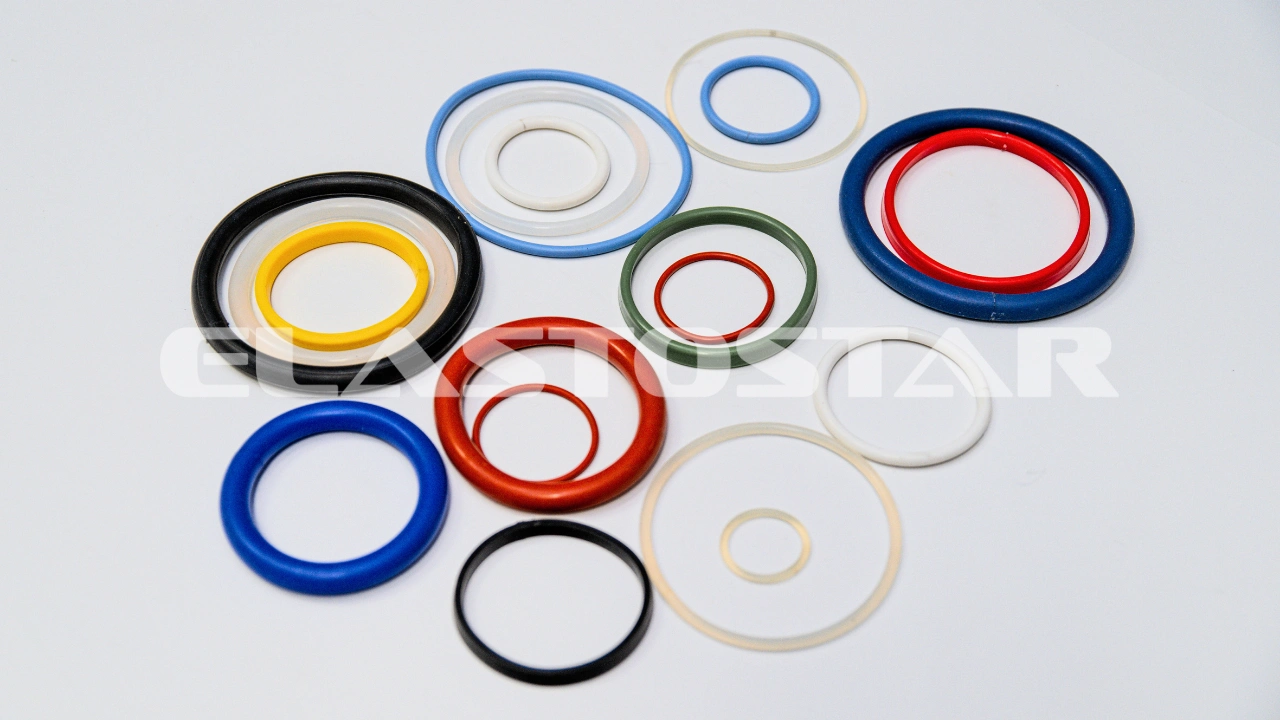
Leaks are one of the most common signs of O-ring failure. Although O-rings are designed to create a secure seal, material selection, installation, groove design, pressure, or lubrication issues can cause them to leak.
In some cases, an O-ring may look fine on the surface but may already be weakened by swelling, cracking, wear, or compression set.
Over time, these issues can compromise sealing performance and increase maintenance costs.
Effective O-ring troubleshooting starts with identifying the root cause, such as chemical incompatibility, excessive pressure, incorrect installation, or poor lubrication, so you can correct the problem before the seal fails completely.
For a better understanding of sealing conditions, learn the difference between static seals and dynamic seals.
Reason 1 – Wrong O-Ring Material Selection
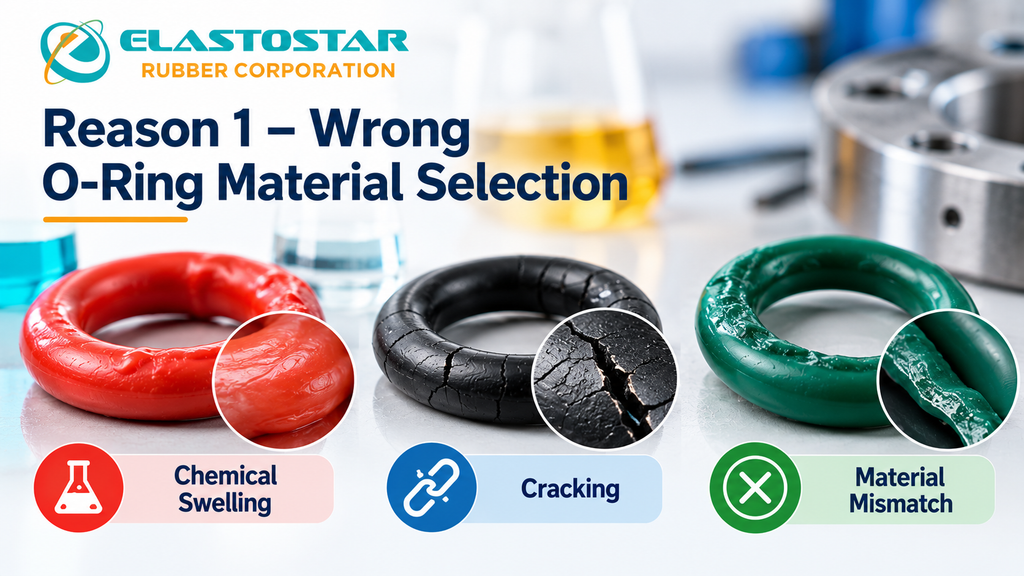
Choosing the wrong material is one of the most common reasons behind FDA silicone O-ring failure.
Each application exposes seals to different chemicals, temperatures, and pressures, so material compatibility is essential.
When the material isn’t suitable, the seal weakens and leaks.
Key issues caused by poor material selection:
- Chemical swelling: Exposure to aggressive solvents or fuels can cause chemical swelling, distorting the seal and reducing effectiveness.
For applications exposed to fuels, oils, and demanding chemical environments, selecting the right Viton®/FKM O-rings or fluorosilicone O-rings can improve compatibility. - Cracking and brittleness: Incompatible elastomers often harden or crack when exposed to certain fluids.
- Shortened service life: Using a standard seal in a harsh environment leads to frequent replacement and downtime.
- When applicable, you can also evaluate material requirements using the ASTM D2000 rubber material classification.
Better solutions:
- Custom silicone O-rings provide reliable performance in high temperatures and many chemical environments.
For food-contact applications, consider material requirements such as FDA 21 CFR 177.2600 silicone rubber, where applicable. - Custom rubber O-rings are designed for specific fluids and conditions, ensuring durability and longer sealing performance.
- For applications involving fuels and aggressive solvents, you can also learn how fluorosilicone O-rings handle aggressive fuels and solvents.
Reason 2 – Incorrect O-Ring Installation
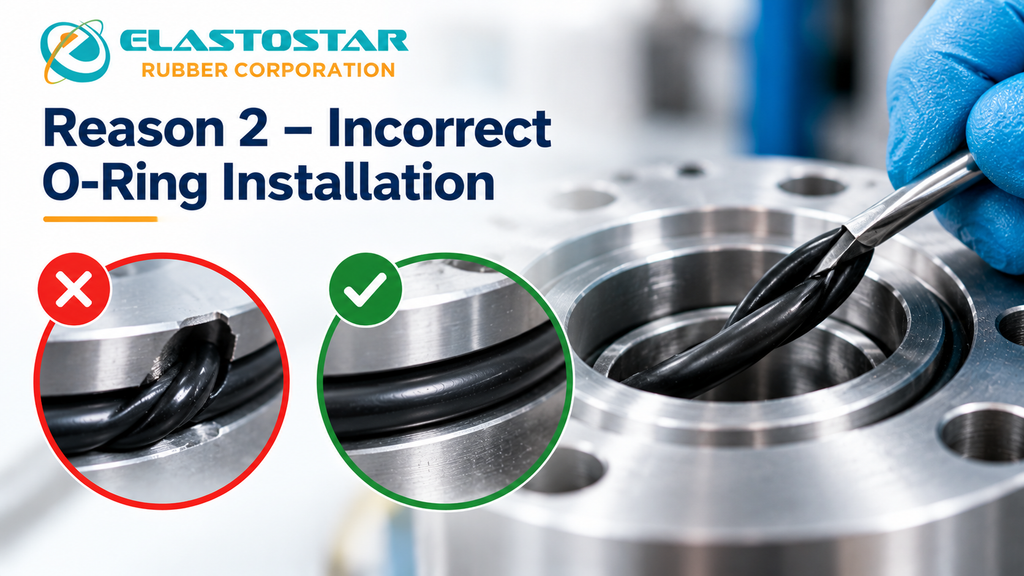
Even the best material won’t last if you install it incorrectly. Small fitting mistakes often turn into major sealing problems.
Common O-ring installation errors include twisting, over-stretching, or forcing the seal into place, all of which create weak spots. Poor groove design and sharp edges can also damage the seal, leading to premature leakage.
Key problems with poor installation:
- Twisting during placement: Leads to uneven stress and early cracking.
- Overstretching the seal: Reduces elasticity and weakens sealing performance.
- Damaged grooves or sharp edges: Cut into the surface, reducing its lifespan.
Better solution:
- Use custom-molded O-rings designed for precise dimensions and proper seating to ensure a reliable fit that prevents leaks.
For applications requiring precise dimensional control, Elastostar Rubber Corporation follows RMA precision tolerance guidelines for rubber components.
Read more: How to Quickly Measure Silicone Rubber O-Rings
Reason 3 – Improper Lubrication
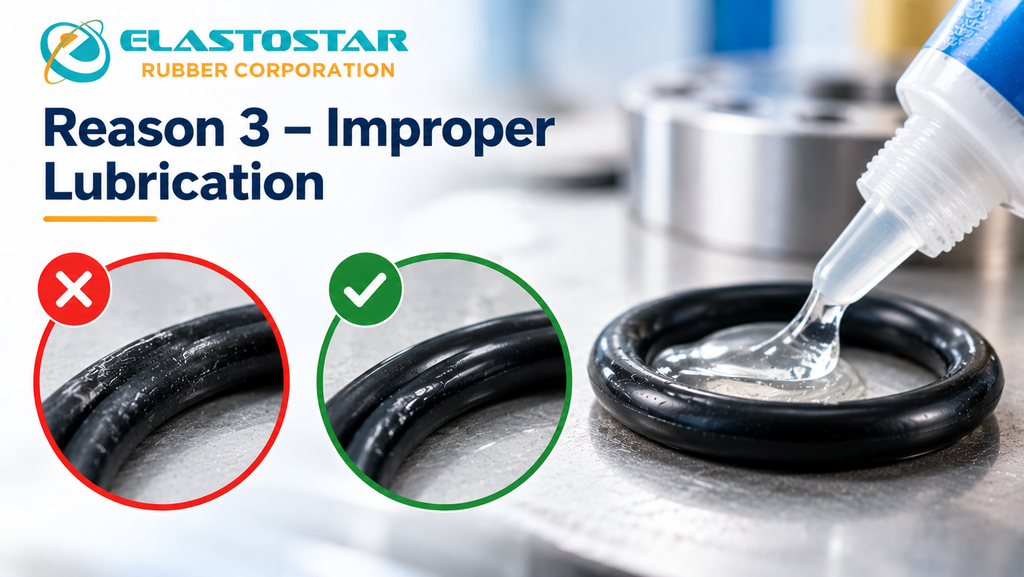
Lubrication is often overlooked, but it plays a vital role in O-ring performance. Without it, seals experience friction, wear, and premature failure.
Many failures trace back to improper O-ring lubrication, especially when seals are installed dry or with the wrong lubricant.
Key problems caused by poor lubrication:
- Dry installation: Increases friction during fitting, causing surface damage and leaks.
- Using the wrong lubricant: Some oils or greases react with elastomers, leading to swelling or cracking. Always consider lubricant compatibility with the O-ring material, whether silicone, nitrile, EPDM, or Viton®/FKM.
- Faster wear and abrasion: Lack of lubrication reduces the O-ring’s life and sealing strength.
Better solutions:
- Follow reliable O-ring maintenance tips, such as applying a compatible lubricant during installation.
- Use manufacturer-recommended O-ring solutions for leaks to ensure smooth installation and longer service life.
Also Read: NITRILE vs EPDM Rubber: Performance Comparison for Seals & Gaskets
Reason 4 – Excessive Pressure and Extrusion
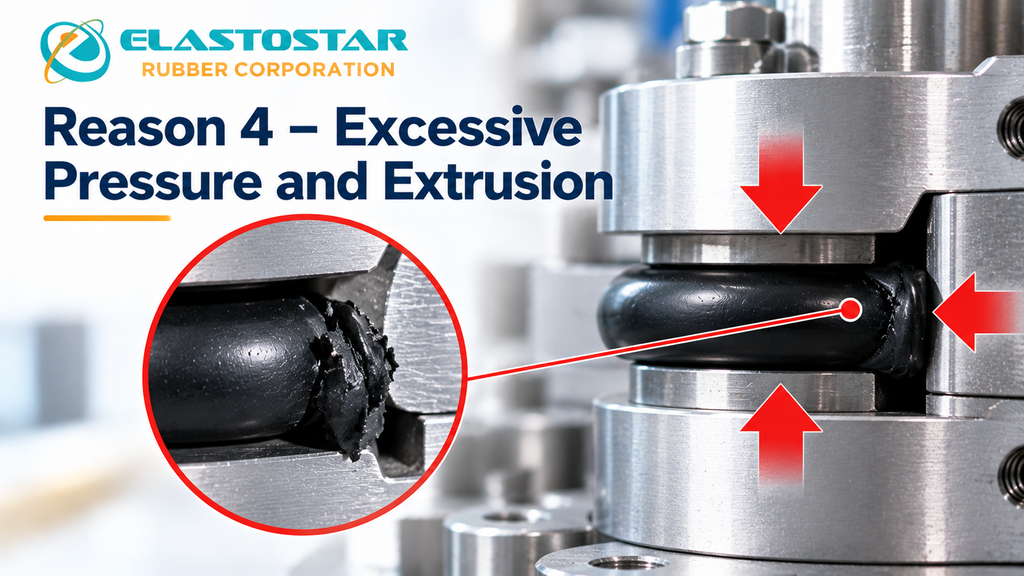
In high-pressure applications, Vulcanized O-rings are pushed beyond their limits.
When internal force becomes too great, seals can be forced out of their grooves, causing O-ring extrusion failure.
This often results in rapid leaks, system inefficiency, and even complete seal blowout.
Key problems caused by excessive pressure:
- Seal extrusion: The O-ring is forced into clearance gaps and damaged by sharp edges.
- Rapid wear: Continuous high pressure grinds away the surface, reducing sealing effectiveness.
- System downtime: Failures in pressurized environments can halt entire operations.
Better solutions:
- Use custom extruded O-rings engineered for high-pressure sealing requirements.
- Choose precision for industrial seals with proper backup rings or groove design to prevent extrusion under extreme loads.
Reason 5 – Temperature Extremes
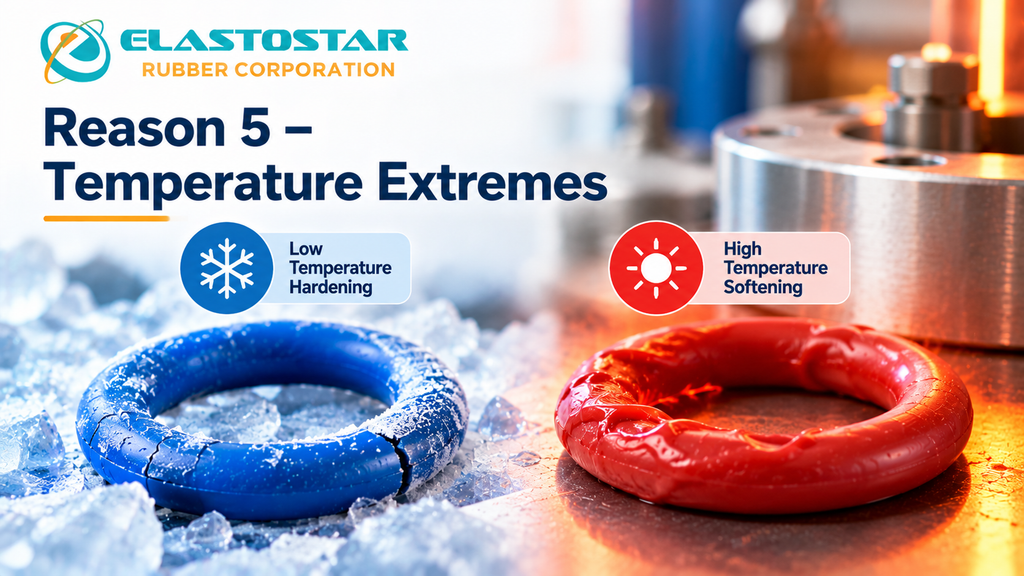
O-rings often fail when exposed to extreme heat or cold.
At high temperatures, seals may harden and lose elasticity, leading to cracks and leaks. In freezing conditions, they can become brittle and break apart.
These issues commonly cause high-temperature silicone O-ring failure and low-temperature seal failure.
Key problems caused by temperature extremes:
- Heat aging: Prolonged heat exposure hardens the material and reduces flexibility.
- Cold brittleness: Seals lose elasticity in cryogenic conditions and crack under stress.
- Reduced sealing life: Continuous temperature swings accelerate wear and leakage.
Better solutions:
- Choose custom-engineered molded O-rings designed for your specific temperature range.
- Select the right material and hardness for the application; see our silicone rubber Shore hardness range for additional guidance.
For more information about temperature-related material performance, read how temperature affects silicone rubber performance.
Reason 6 – Compression Set
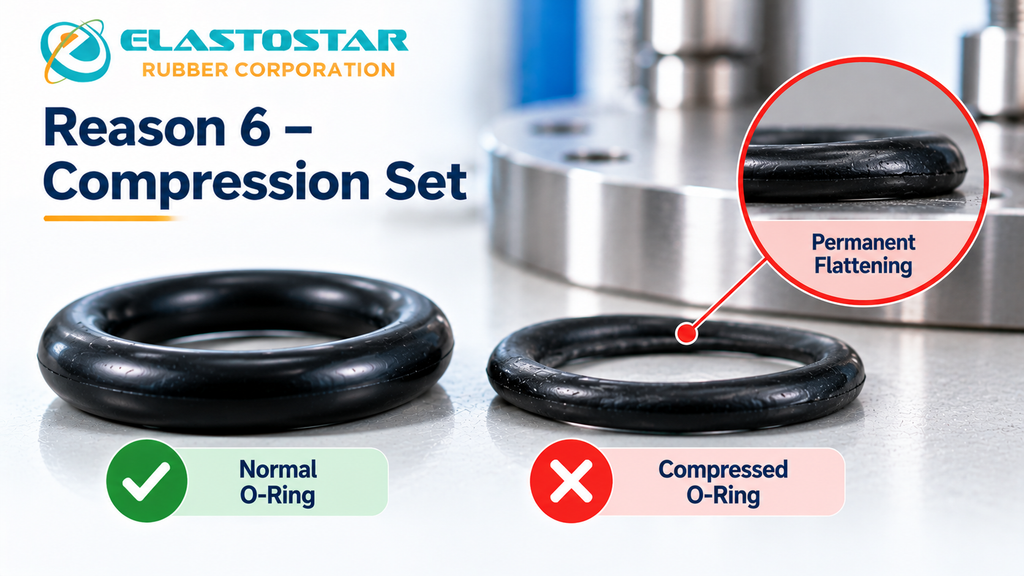
Over time, O-rings can lose their ability to spring back to their original shape. This permanent deformation, known as O-ring compression set, reduces sealing strength and often leads to leaks.
It usually happens when seals are exposed to high heat, long-term stress, or poor groove design.
Key problems caused by compression set:
- Flattened sealing surface: Constant pressure deforms the O-ring, leaving gaps for leaks.
- Heat damage: Elevated temperatures accelerate compression and loss of sealing.
- Design flaws: Poor tolerances or groove design problems make seals more likely to fail.
Better solutions:
- Select precision for industrial seals designed to resist compression and maintain elasticity.
- Ensure correct groove dimensions and material selection to reduce long-term deformation.
Read More– O-Ring Size Standards & International Size Charts
Reason 7 – Wear and Tear Over Time
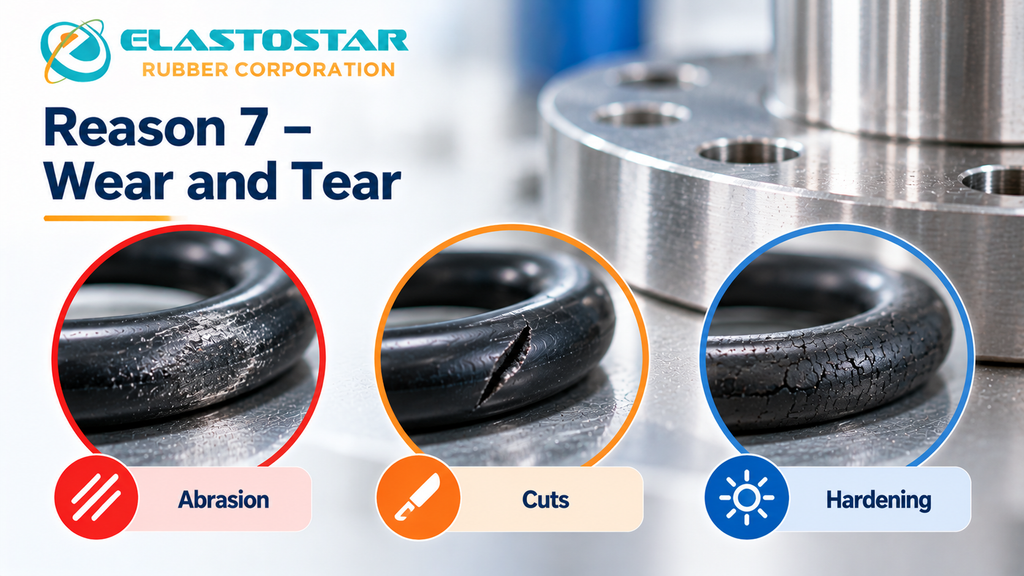
Even with proper installation and material selection, hot-sliced O-rings don’t last forever. Continuous movement, pressure changes, and environmental stress eventually cause wear.
Over time, surfaces become scratched or abraded, reducing sealing performance and leading to leaks.
Key problems caused by wear and tear:
- Surface abrasion: Repeated friction slowly wears away the seal’s material.
- Loss of elasticity: As seals age, they lose flexibility and become less effective.
- Unexpected leaks: Seals often fail suddenly if they aren’t checked regularly.
Better solutions:
- Follow regular maintenance tips with scheduled inspections and replacements.
- Use custom O-rings engineered for longer service life in demanding industrial environments.
For more guidance on service life, read how long fluorosilicone O-rings last.
What are the Signs Your O-Rings Are About to Fail?
Spotting problems early can save time, money, and prevent costly breakdowns.
A quick FDA O-ring troubleshooting guide can help you recognize when seals are nearing the end of their life cycle.
Common warning signs include:
- Visible cracks or cuts: Surface damage that quickly develops into leaks.
- Flattened or deformed seals: A sign of compression set and loss of flexibility.
- Swelling or softening: Often caused by chemical incompatibility.
- Frequent small leaks: Even minor seepage indicates the need for inspection.
For long-term reliability, switch to engineered solutions for leaks, combined with regular inspections and timely replacements.
Read more: What Are the Uses of Silicone O-Rings?
How to Prevent O-Ring Leaks?
The right approach can prevent most sealing failures.
Effective O-ring failure prevention starts with choosing the right materials, installing properly, and inspecting regularly. Addressing these basics ensures longer service life and reduces costly downtime.
Best practices for preventing leaks:
- Select the right material: Choose O-rings based on chemicals, temperature, pressure, and application requirements. For medical and pharmaceutical applications, USP Class VI silicone rubber may be required.
- Install correctly: Avoid twisting, stretching, or damaging grooves during installation.
- Maintain regularly: Follow reliable O-ring maintenance tips to detect cracks, swelling, or wear early.
- Design correctly: Ensure precise grooves and tolerances to reduce stress, compression set, and leaks.
By applying these measures, industries can extend seal performance and prevent premature leakage.
When to Use Custom O-Rings?
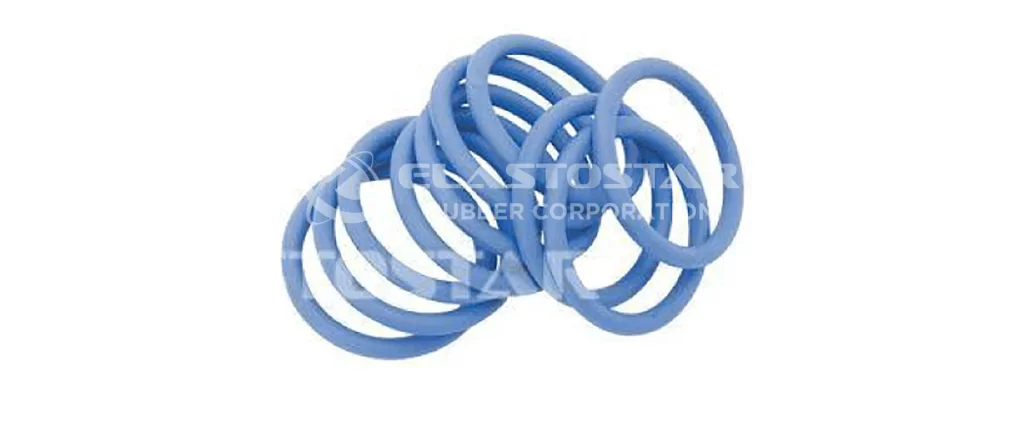
Standard seals can handle general applications, but demanding environments often require customized solutions.
This is where custom O-rings from trusted O-ring manufacturers improve both performance and reliability.
Situations where custom solutions are essential:
- Unique operating conditions: High pressure, extreme temperatures, or chemical exposure may call for custom-engineered O-rings.
- Precise dimensions: Applications with tight tolerances benefit from custom-molded O-rings designed to fit grooves accurately and prevent leaks.
- Continuous heavy use: Industrial and aerospace systems often require O-rings designed for demanding service conditions.
For aerospace applications, working with an AS9100D-certified rubber manufacturer can support industry-specific quality requirements.
With experienced O-ring manufacturers, we ensure every seal is engineered for your exact application, delivering durability, safety, and consistent results.
Why Choose Elastostar Rubber Corporation for Custom O-Rings?

When standard O-rings cannot meet specific dimensional, material, or operating requirements, choosing an experienced custom O-ring manufacturer can help address the underlying causes of sealing failure.
Elastostar Rubber Corporation provides custom rubber sealing solutions with manufacturing and technical support for demanding industrial applications.
Our Key Manufacturing Strengths
- Custom Manufacturing: We manufacture custom O-rings to meet specific size, material, dimensional tolerance, and application requirements.
- Large Manufacturing Facility: Our manufacturing infrastructure supports custom rubber component production and ongoing customer supply requirements.
- Proudly Made in USA: Our USA-based manufacturing supports customers looking for domestically manufactured rubber sealing solutions.
- Reverse Engineering Support: We help customers reproduce existing O-rings and sealing components when original drawings or specifications are unavailable.
- Prototype-to-Production Capability: We support product development from initial prototypes and samples through repeat production runs.
- Design Help and Application Support: Our team assists with material selection, dimensions, groove fit, and application-specific sealing requirements to help address potential leakage problems.
- Short Lead Time Delivery: We focus on efficient manufacturing and delivery to help customers reduce delays when sourcing custom O-rings. Lead times depend on the product specifications and order requirements.
Need a Custom O-Ring Solution?
If recurring leaks, unusual dimensions, or material compatibility issues affect your equipment, Elastostar Rubber Corporation can help you evaluate your sealing requirements.
Contact our team with your O-ring dimensions, material specifications, operating conditions, and required quantities to discuss a custom manufacturing solution.
Recommended Reads
- High Temperature O-Rings for Industrial Applications
- FDA Metal Detectable Silicone Rubber O-Rings, Seals & Gaskets
- Custom Silicone O-Rings: Leading Manufacturer in the USA and Canada
Conclusion
O-ring failures may seem small, but they can lead to costly downtime, equipment damage, and safety risks. Understanding common O-ring failure causes, including incorrect material selection, installation errors, pressure, temperature, compression set, and wear, makes prevention easier.
Choosing the right rubber O-rings, following proper installation practices, and performing regular maintenance can significantly reduce leaks and premature failure.
For demanding applications, custom O-rings can provide the right material, size, and sealing performance for specific operating conditions.
Frequently Asked Questions (FAQ)
Q1. What are the most common reasons O-rings fail?
Common causes of O-ring failure include incorrect material selection, improper installation, lack of lubrication, exposure to extreme temperatures, high pressure causing extrusion, and long-term wear and tear. Each factor weakens the seal and increases leak risk.
Q2. Why do my O-rings keep leaking even after replacement?
If O-ring leaks continue after replacement, the issue may be groove design mistakes, installation errors, or using an incompatible material. A proper O-ring troubleshooting guide can help identify the real cause and prevent repeat failures. For expert advice, contact Elastostar Rubber Corporation.
Q3. How does incorrect installation damage O-rings?
Common O-ring installation errors include twisting, overstretching, or forcing the seal into place. These mistakes weaken the surface, leading to cracks or early leaks. Using custom-molded O-rings can reduce these risks by ensuring a precise fit.
Q4. What materials are best for chemical-resistant O-rings?
For strong chemical compatibility, fluorosilicone, Viton®/FKM O-rings, and specially formulated custom rubber O-rings may be suitable, depending on the chemical and operating conditions. These materials can resist swelling and cracking in compatible applications, providing longer service life.
Q5. Can lubrication extend the life of O-rings?
Yes. Proper lubrication prevents friction and surface damage during installation and operation. Avoid improper O-ring lubrication by using only compatible lubricants. This is one of the best O-ring maintenance tips for extending seal performance.
Q6. How do I prevent O-ring extrusion in high-pressure applications?
To prevent O-ring extrusion failure, choose seals with the correct hardness, use backup rings, and ensure proper groove design. Custom O-rings may be used for demanding high-pressure sealing systems.
Q7. What is an O-ring compression set, and how can it be avoided?
O-ring compression set is when the seal loses its ability to return to its original shape, leaving gaps that cause leaks. To avoid this, use heat-resistant materials and follow proper O-ring groove design practices.
Q8. Are custom O-rings better than standard O-rings?
Custom O-rings can be a better choice for demanding or application-specific conditions. Custom-engineered O-rings can meet specific temperature, chemical, pressure, and dimensional requirements. For automotive applications, working with an IATF 16949-certified manufacturer can also help meet quality requirements.
Q9. When should I replace my O-rings to prevent leaks?
Replacement depends on the application, but regular inspections are key. Follow O-ring maintenance tips, including checking for cracks, swelling, flattening, loss of elasticity, or other signs of wear. Replace O-rings based on their condition and application requirements.
Q10. Where can I order custom silicone O-rings in the USA?
You can buy custom silicone O-rings from trusted manufacturers such as Elastostar Rubber Corporation. We provide custom-molded O-rings and material options for different applications, including solid, FDA-grade white silicone rubber for food-contact applications.