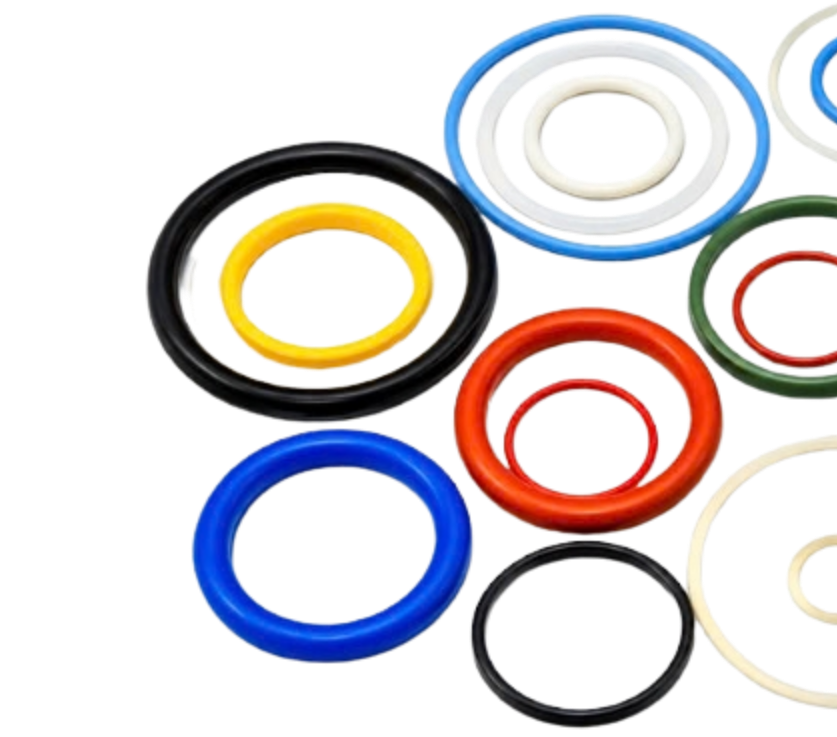
Nitrile (NBR / Buna-N) O-Rings
Nitrile O-rings, also known as NBR or Buna-N O-rings, are widely used in sealing applications requiring resistance to petroleum-based oils, greases, lubricants, fuels, and many hydraulic fluids.
Nitrile Butadiene Rubber combines oil resistance, abrasion resistance, mechanical strength, and reliable sealing performance, making it a practical elastomer for hydraulic, pneumatic, automotive, industrial, and OEM applications.
Elastostar Rubber Corporation manufactures standard and custom Nitrile O-rings, seals & gaskets in different sizes, hardness levels, and compound requirements.
Key Characteristics of Nitrile Rubber
NBR is commonly selected where oil resistance and mechanical durability are important.
Oil resistance
Good resistance to many petroleum and mineral oils.
Fuel resistance
Suitable for many fuel applications with the appropriate compound.
Abrasion resistance
Good wear characteristics for many mechanical applications.
Mechanical strength
Provides useful tensile and tear properties.
Compression performance
Suitable for static sealing when properly formulated and specified.
Hardness versatility
Available in different Shore A hardness levels for different sealing requirements.
Nitrile O-Ring Technical Properties
| Property | Typical NBR Characteristics |
| Material | Nitrile Butadiene Rubber (NBR) |
| Common Name | Nitrile / Buna-N |
| Typical Temperature Range* | Approx. -30°F to 250°F (-34°C to 121°C) |
| Common Hardness | Around 70 Shore A; other hardnesses available depending on formulation |
| Oil Resistance | Good to excellent |
| Abrasion Resistance | Good |
| Weather / Ozone Resistance | Limited |
| Primary Uses | Oils, lubricants, hydraulic fluids and compatible fuels |
*Values are general material guidelines. Actual performance depends on the specific compound, hardness, media, pressure, and operating conditions.
Acrylonitrile (ACN) Content
NBR is produced from acrylonitrile (ACN) and butadiene, and the ACN level influences its performance.
Higher ACN content generally provides better resistance to petroleum oils and fuels, but reduces low-temperature flexibility.
Lower ACN content generally improves low-temperature flexibility, with a corresponding reduction in oil and fuel resistance.
For demanding applications, the specific NBR compound should therefore be selected according to both fluid exposure and operating temperature.
Nitrile Temperature & Hardness
General-purpose NBR compounds may typically operate around -30°F to 250°F (-34°C to 121°C), although the actual service range varies by formulation.
Nitrile is available in multiple Shore A hardness levels, with approximately 70 Shore A commonly used for general-purpose O-rings.
Harder or softer compounds may be specified according to pressure, squeeze, extrusion clearance, and gland design.
For critical sealing applications, the temperature and hardness specifications of the actual compound should always be used.
Chemical & Fluid Compatibility
Nitrile is primarily selected for its resistance to petroleum-based media.
Commonly Compatible With
- Petroleum-based oils.
- Mineral oils.
- Lubricating oils and greases.
- Many hydraulic fluids.
- Certain fuels.
Aliphatic hydrocarbons.
Compatibility should always be verified against the specific media, temperature, concentration, and exposure conditions.
Nitrile Limitations
Standard NBR generally has limited resistance to ozone, prolonged weather exposure, and UV. It may also be unsuitable for certain ketones, esters, chlorinated hydrocarbons, and other aggressive chemicals.
For outdoor and weather-resistant sealing, EPDM may be more appropriate. For higher temperatures and broader resistance to many oils, fuels, and chemicals, Viton®/FKM may be considered.
Nitrile Grades & Specifications
NBR compounds can be formulated according to required hardness, temperature capability, oil and fuel resistance, compression properties, and mechanical performance.
Applicable requirements may include:
- ASTM D1418 – rubber polymer nomenclature.
- ASTM D2000 / SAE J200 – rubber material classification.
- AS568 – standard O-ring dimensions.
- SAE specifications – where applicable.
- OEM material specifications.
- Customer drawings and requirements.
Common Nitrile O-Ring Applications
Nitrile O-rings are commonly used in:
Hydraulic equipment
cylinders, pumps, valves, and fittings.
Pneumatic systems
cylinders, valves, and compressed-air equipment.
Automotive components
oil systems, transmissions, pumps, and compatible fuel applications.
Industrial machinery
gearboxes, compressors, and lubricated equipment.
Pumps & valves
static and dynamic fluid sealing.
OEM equipment
custom oil-resistant sealing components.
Custom Nitrile O-Rings from Elastostar Rubber Corporation
Elastostar Rubber Corporation manufactures custom Nitrile O-rings, gaskets, seals, and molded rubber components for industrial and OEM requirements.
Custom NBR components can be manufactured based on:
- Standard or non-standard dimensions
- Required Shore A hardness
- Material or compound specifications
- Drawings or CAD files
- Existing samples
- Production requirements
Elastostar’s custom rubber manufacturing capabilities support applications requiring specific dimensions, tolerances, material properties, and operating requirements.
Quality and manufacturing information is available on Elastostar’s Certificates & Accreditations.
Nitrile O-Ring FAQs
Yes, nitrile rubber is commonly referred to as NBR or Buna-N. NBR stands for Nitrile Butadiene Rubber.
NBR provides good resistance to many petroleum-based oils, mineral oils, lubricants, and greases. Compatibility should still be verified for the specific fluid and operating conditions.
General-purpose NBR compounds may typically operate around -30°F to 250°F (-34°C to 121°C). Actual limits depend on the compound formulation and service conditions.
Nitrile can be manufactured in different Shore A hardness levels. Approximately 70 Shore A is common for general-purpose O-rings, while other hardnesses may be selected for specific pressure and sealing requirements.
Standard NBR has limited resistance to ozone, UV, and prolonged weather exposure. EPDM or another weather-resistant elastomer may be better suited when outdoor exposure is a primary requirement.
Need Custom Nitrile O-Rings?
Send us your dimensions or drawing, required hardness, operating temperature, pressure, media exposure, specification, and quantity to discuss a standard or custom NBR sealing requirement.